
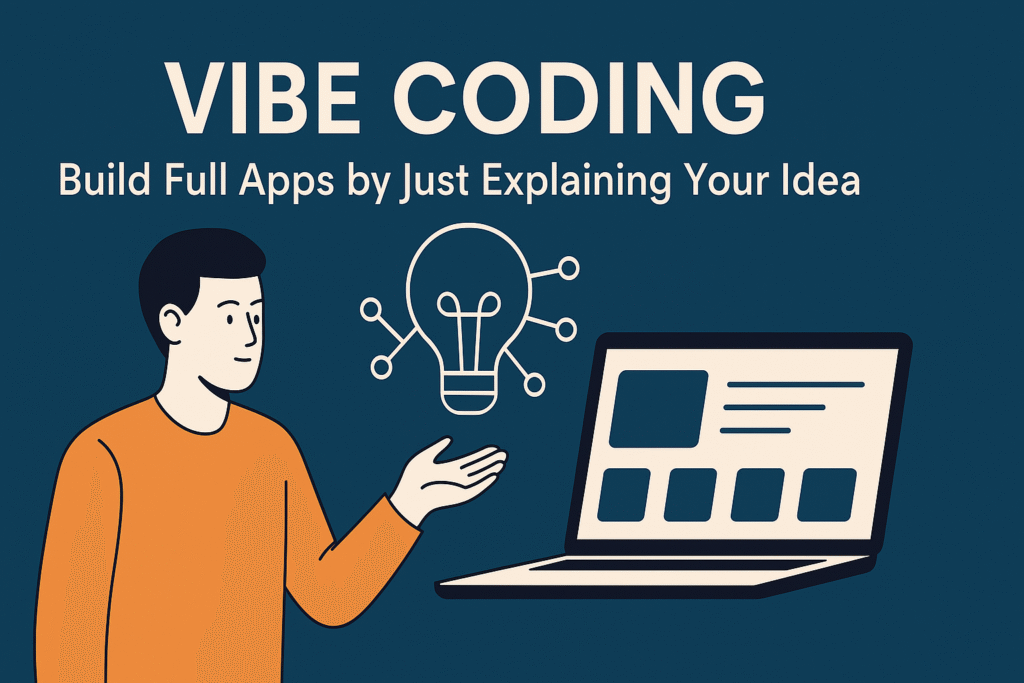
Imagine building an entire app without touching a single line of code—just by explaining your idea in plain English. This is not science fiction anymore. It’s the promise of Vibe Coding, an emerging AI-powered paradigm that enables developers, entrepreneurs, and creators to build full-stack applications simply by describing their vision. As artificial intelligence continues to advance in natural language processing and code generation, Vibe Coding has the potential to revolutionize software development as we know it.
What is Vibe Coding?
Vibe Coding is an AI-assisted approach to software development where you communicate your idea in natural language, and the AI translates that into functional code. It leverages technologies like generative AI, large language models (LLMs), and no-code/low-code frameworks to produce apps that meet your vision with minimal manual coding.
How It Works
At its core, Vibe Coding involves describing your project—whether it’s a to-do app, e-commerce store, or SaaS product—and letting the AI handle the architecture, database, frontend, backend, and even deployment scripts.
- You describe your app: “I want a web app where users can create and manage fitness routines.”
- The AI interprets the request using NLP and generates structured components.
- Code is produced and wired together into a complete project scaffold.
- Deployment instructions or hosting setup is also provided.
Key Features of Vibe Coding
Vibe Coding is not just another no-code tool. It combines the power of modern LLMs with customizable developer control, making it versatile for both non-coders and experienced devs.
- Natural Language Interface: Communicate your vision just like chatting with a human.
- Code Generation: Auto-generates code in languages like JavaScript, Python, React, Node.js, etc.
- Prompt-Based Refinement: Easily modify functionality with follow-up prompts.
- Multi-stack Support: Choose from full-stack templates (MERN, MEVN, Django, etc.).
- Deployment Ready: One-click deployment via platforms like Vercel, Netlify, or Docker.
Real Prompt Example
"Build a task management web app with login/signup using Google auth, and store tasks in MongoDB. The UI should be modern with light and dark themes. Users should be able to create, edit, delete, and filter tasks."
Based on the prompt above, Vibe Coding tools like Cursor or Replit AI can generate a functioning app structure with responsive design, backend APIs, and basic authentication—without needing a manual setup.
Why Vibe Coding is Game-Changing
1. Time-Saving for Developers
Traditionally, building apps involves dozens of repetitive tasks—from file scaffolding to connecting APIs. With Vibe Coding, developers can skip the boilerplate and get straight to customization or innovation.
2. Low Barrier to Entry
For beginners and non-tech founders, Vibe Coding democratizes app creation. You no longer need to learn programming to turn your idea into a working prototype.
3. Scalability and Customizability
Unlike traditional no-code platforms, Vibe Coding allows exporting or extending the codebase. You can start with AI and later hand over to a development team for scaling or fine-tuning.
Popular Vibe Coding Tools in 2025
- GPT Engineer – Lets you generate entire applications with code and architecture using prompt engineering.
- Builder.io – AI-driven visual app builder with React code export options.
- FlowGPT – A community of pre-built AI prompts including app-building blueprints.
- NoCode AI – Drag-and-drop meets natural language generation for hybrid dev.
Use Cases: Who Can Benefit?
Entrepreneurs and Startups
Need an MVP in a week? Just explain the product, and let the AI generate it. It’s ideal for validating startup ideas at lightning speed.
Freelancers and Agencies
Deliver client projects faster with AI-generated foundations. Use prompts like:
"Create a portfolio website with sections for About, Projects, Contact, and a blog CMS."
Students and Hobbyists
Want to build a project for your portfolio? Vibe Coding makes it possible to go from idea to GitHub commit within hours.
Challenges and Limitations
Accuracy and Interpretation
AI sometimes misinterprets requirements or creates insecure code. Reviewing and testing is still essential.
Complex Logic Handling
Building apps with advanced business logic may require manual intervention or expert prompt tuning.
Dependency Management
AI-generated projects can have bloated dependencies or outdated packages, needing developer review.
Tips to Get the Best Output from Vibe Coding
- Be specific in your prompts — include technologies, UI style, and features.
- Use iterative prompting — refine functionality step-by-step.
- Use trusted tools with exportable code.
- Review AI-generated code for security and performance.
Internal Resources You Might Like
Vibe Coding vs Traditional Development
- Speed: Vibe Coding wins for prototyping; traditional wins for complex systems.
- Control: Traditional coding gives more control, but Vibe is catching up with customization.
- Learning Curve: Vibe has minimal barrier; traditional requires programming knowledge.
The Future of Vibe Coding
With OpenAI’s evolving models and other players like Anthropic and Meta entering the space, the future of Vibe Coding is bright. Soon, voice-to-app or AR-based development could emerge, taking this idea further. AI agents could soon handle deployment, A/B testing, and even user feedback analysis.
Final Thoughts: Is Vibe Coding the Future?
Vibe Coding is not a replacement for traditional development—at least not yet. But it’s certainly a paradigm shift. By making app development faster, more accessible, and less intimidating, it empowers more creators to bring their ideas to life. Whether you’re a startup founder, solo developer, or curious learner, Vibe Coding is worth exploring.
If you want to dive deeper into AI-powered tools and prompts, make sure to explore more resources on our site. Bookmark this page, share it with fellow tech enthusiasts, and start building smarter—not harder.