
Agentic AI: How Autonomous Agents Are Replacing Daily Tasks
A practical look at how agentic AI systems now automate daily routines with minimal oversight.
Why agentic AI matters today
Agentic AI is transforming how tasks get done — operating proactively rather than reactively. With autonomous agents now performing daily tasks like booking meetings, drafting emails, or managing your calendar, agentic AI is shifting us away from prompt-based interactions and toward goal-focused automation. In this post, you’ll learn what agentic AI is and how it replaces mundane daily chores using minimal oversight.
What Is Agentic AI?
Definition & Key Traits
Agentic AI refers to a class of intelligent systems that plan and act toward goals independently of constant human input, using reasoning and external tools.
Unlike traditional generative AI (such as ChatGPT or Copilot), agentic AI agents operate autonomously: they perceive their environment, reason over multiple steps, plan sub‑tasks, execute actions (often via APIs or web interfaces), and adapt to feedback. This allows them to close loops toward defined objectives—without waiting for each new prompt. This behavior aligns with the classic definition of an autonomous agent that senses, plans, and acts over time (see learning agent or intelligent agent descriptions).
Core Characteristics
- Autonomy: agentic AI agents work toward goals without micro‑management.
- Multi‑step planning: they break goals into sequenced actions.
- Goal orientation: they measure success and can stop or retry.
- Tool integration: they invoke APIs, browser automation, or database queries.
- Iterative learning: they observe outcomes and improve over time.
Agentic AI thus extends beyond reactive LLM responses to a framework where systems act more like virtual employees. They resemble the multi‑agent systems used in enterprise automation but are powered by modern AI models and reasoning abilities.
How Autonomous Agents Are Replacing Daily Tasks
Real‑world Examples & Use Cases
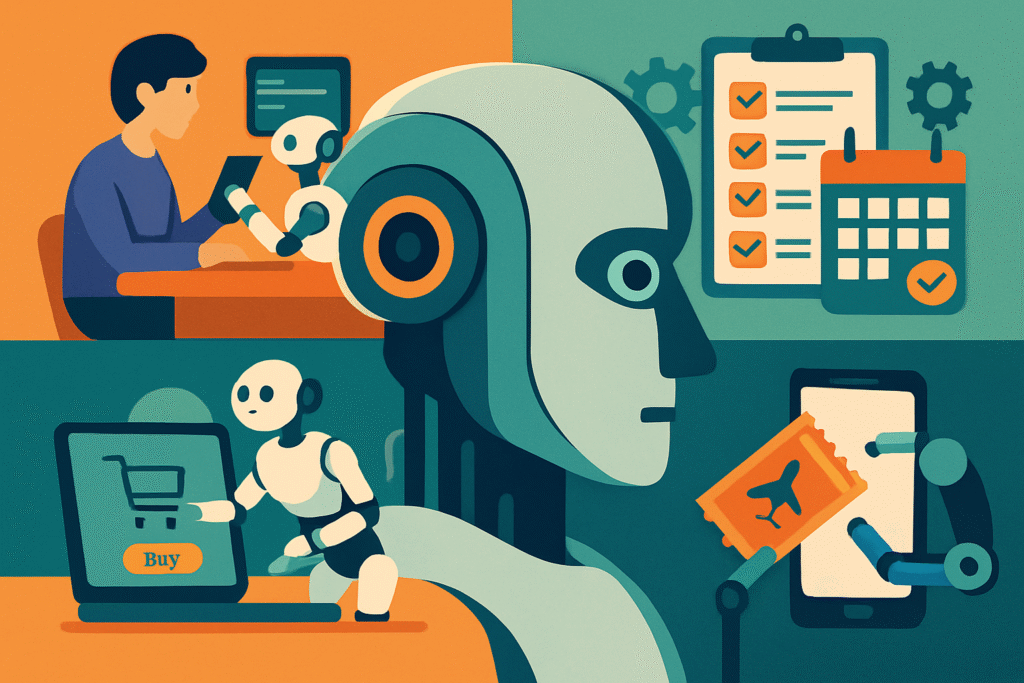
Across personal and professional life, agentic AI agents are taking over tasks big and small.
- Personal Assistants: Tools like OpenAI Operator book appointments, fill web forms, and even initiate customer follow-ups—based on your goal instructions rather than specific prompts.
- Workday Automations: Agents now handle meeting scheduling, invoice reminders, lead follow-ups, and CRM clean‑ups—especially useful in small teams or freelance operations.
- Consumer Services: Shopping agents compare prices, email agents summarize messages or highlight actionable threads, and ticket‑booking agents coordinate travel bookings automatically.
For examples of AI tools automating an entire day—from scheduling and note‑taking to reporting—you can explore the NeoToolsKit guide “How to Automate Your Entire Day with AI (Step‑by‑Step)” . Similarly, if you’re curious about hidden tools that act as lightweight agents, check out NeoToolsKit’s “Hidden AI Tools 2025,” which includes agents for productivity and task automation across domains like content creation, transcription, and study workflows .
Benefits & Risks
Optimizing productivity—and managing caution
You’ll gain efficiency—but responsibility scales, too.
- Productivity boost: Delegating repetitive tasks frees mental bandwidth.
- Round‑the‑clock availability: Agents don’t sleep, enabling 24/7 operations.
- Consistency: Well‑configured agents often reduce human error.
However, risks are real:
- Hallucinations: Agents may misinterpret goals or invent details.
- Bias & compliance issues: Flawed training data or lack of oversight could lead to misuse.
- Over‑automation: Agents might execute beyond intended scope if not constrained.
- Security concerns: Granting tools too much access can expose private data.
“Deploying agentic AI is like hiring a digital assistant—you must define the job description clearly, or you’ll end up with unexpected outcomes.”
If you’re curious about safe agent implementation, NeoToolsKit’s article on how to automate your day offers a structured approach, including fail‑safe checks and human review points .
How to Think About AI as a Virtual Employee
Guidance for solopreneurs and small teams
Treat agentic AI like a team member—define roles, monitor progress, and keep control.
- Define clear roles: Specify exactly what the agent should—and shouldn’t—do.
- Start small: Assign non‑critical tasks before expanding to workflows.
- Use checkpoints: Let agents propose actions but require approval at key steps.
- Track performance: Maintain logs and dashboards of agent actions, successes, and errors.
- Continuously evaluate: Review and tweak agent behavior monthly as tools evolve.
For deeper context, explore how people are using ChatGPT and AI tools to streamline prompts and workflows in NeoToolsKit’s posts on ChatGPT productivity prompts .
Conclusion
From prompts to autonomous agents
Agentic AI is not just a trend—it’s a move toward delegating with confidence.
We’ve entered a new phase in AI: one where we set goals and intelligent agents autonomously deliver results. With agentic AI, your daily tasks—from scheduling to content synthesis—can be managed with limited oversight, freeing you to do higher‑value work. As agentic AI continues to evolve, consider this: you’re not just using an AI model—you’re assigning a virtual team member.
Want to keep building smarter systems and agentic routines? Visit NeoToolsKit’s blog section for ongoing case studies, tips, and tool updates related to agentic AI and intelligent assistance across 2025 and beyond. And don’t forget: always set goals first, then let your agentic AI do the rest.